
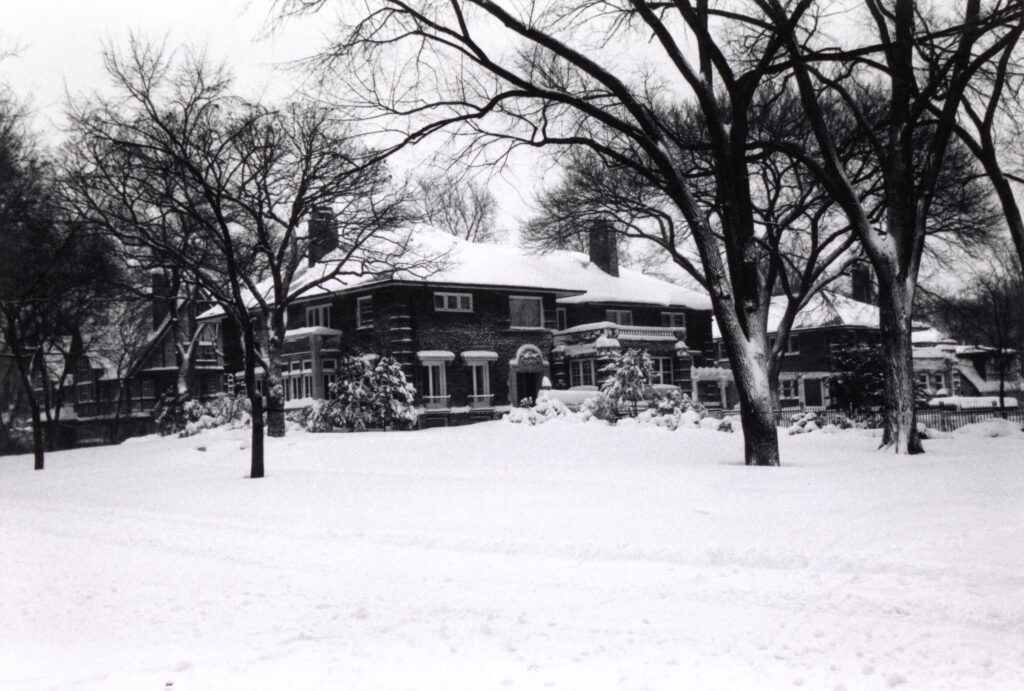
In 1983, the Claretians living at the Provincial house in Oak Park, Illinois, decided to participate in the neighborhood’s Wright Plus walk. This was a one-day, per year, event that allowed visitors to tour 11 homes in the area. Wright Plus did their own research on each house and while processing the Provincial House collection, we found research materials and tour guide documents from the Wright Plus group. From these materials, we discovered a bit of history about the house.

The home was built in 1912 for Emery Fahrney designed and constructed by Charles White, who worked for Frank Lloyd Wright from 1903 to 1905. He is believed to be one of the originators of the Early Modern and Simplified Rectilinear style of architecture. Some characteristics of White’s style that can be seen in the Provincial House are:
A basic rectangular design
Plain façade with considerable blank wall space
Use of varied window groupings and sizings (casements, double hung, French doors)
High chimneys with concrete crowns
Restrained use of classical decoration like the main entrance done in an abstract adaptation of a Palladian window motif
The research from Wright Plus shows that it was designated as the “Fireproof” house based on the request from Fahrney to White to include features that made it a fire-safe home, at the time. The house’s structure, including floors between levels, is concrete and the exterior is faced with brick, both fireproof materials. A fire escape was included in the original blueprints for the building, but this was eventually discarded in place of having balconies on each of the second floor rooms to provide an escape from fire for habitants. Finally, the central heating source was placed in the carriage house, not the main abode.

Purchased for around $97,000 by the Claretians, the Fireproof house has had four owners. The original Fahrney family sold the home to the Healys in 1937. They sold it to Helen and Robert Dowling in 1954 before it was sold to the Claretians in 1962.
Since then, the Claretians have stewarded the home, utilizing it daily as a home for resident and visiting priests and brothers. They also host annual celebrations, all the while ensuring that it lives up to its historic legacy.