
Fr. Peter Rodríguez (1931–2004) moved to the United States in his twenties to study English for Claretian missions in Japan. Instead, the soft-spoken, scholarly Spaniard was ordained in Chicago, taught briefly at St. Jude Seminary, then devoted the rest of his life to Spanish-speaking ministry in Chicago. Assigned to St. Francis of Assisi Church in 1961, he initially lacked the confidence to preach. He later reflected, “I didn’t like pastoral work because my field of expertise was literature and education. Little by little, I found my identity as a priest and a human being. The Mexicans and Puerto Ricans who attended St. Francis of Assisi helped me much more than I helped them.” He would serve at St. Francis for seventeen years. He grew into a voice for the voiceless there and, more broadly, for Chicago Latinos.
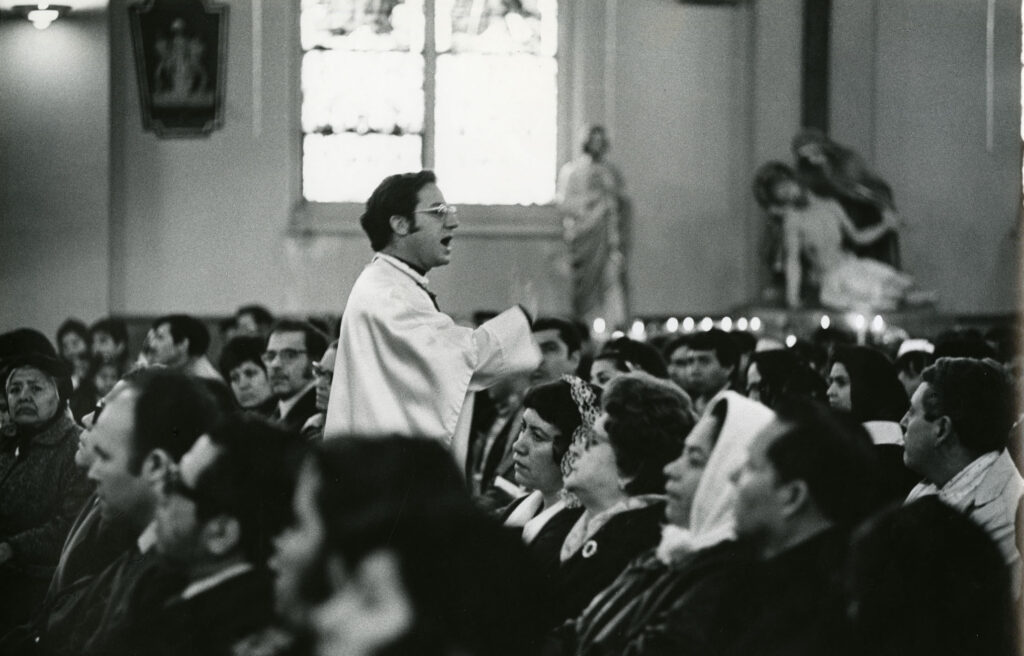
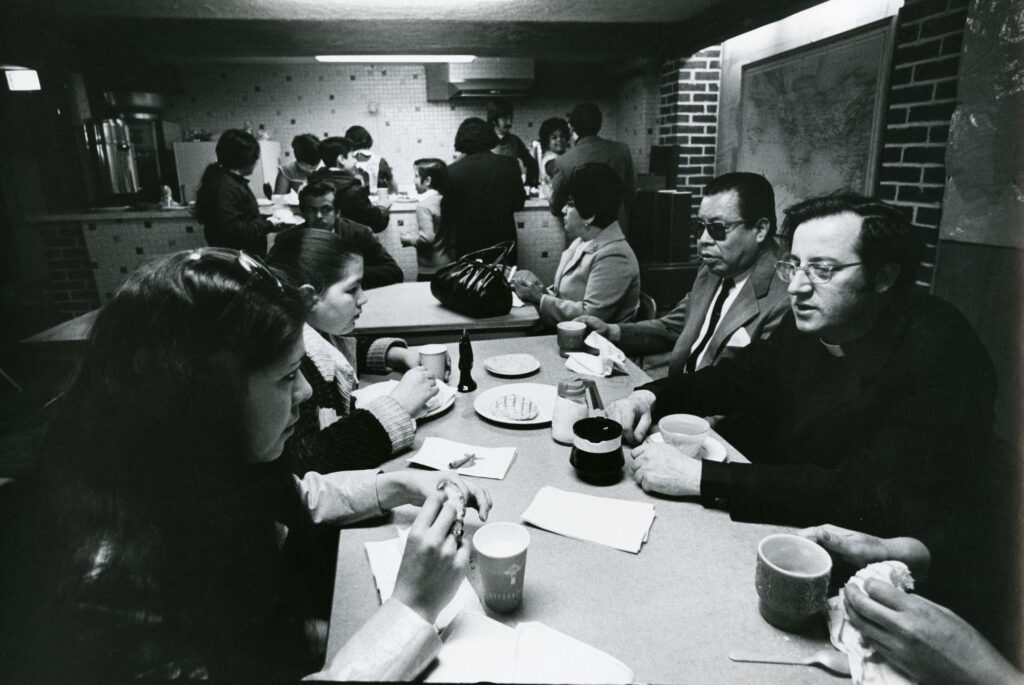
Rodríguez’s Spanish roots did not hamper his relationships with Latin American parishioners. Padre Pedro connected with people over coffee and pan dulce (sweet bread) in church halls after Mass, listened at the well-attended meetings of the JOC (Young Catholic Workers), or directed a choir. Spanish-speakers throughout the city knew the priest through his columns in various Spanish-language papers, radio programs, and finally on television. St. Francis stands in the city’s center. Latino people, especially immigrants, took the train and buses from their homes on the north, south, and west sides, even the suburbs to St. Francis. To many Mexicans in Chicago, he was “a cool priest”, or in a Mexican play on words, “un padre muy padre.” St. Francis of Assisi Church thrived in the 1960s. I talked with many new arrivals from Mexico who arrived at St. Francis and found it welcoming. Smiling, they often recalled Padre Pedro and his impact on their lives.
Rodríguez made it clear that being a priest was not just celebrating Mass on Sundays, but to create Church everywhere a priest went. He spoke out during his homilies and further urged action standing with people in front of the churches where he served. Even before Vatican II, Rodríguez took on social justice causes. He accompanied striking workers on the picket lines at Chicago’s Zenith factories, nationally known for manufacturing radio and television sets. He castigated Immigration and Naturalization Services (INS) agents for actions in which they racially targeted people in at the city’s bus stops, in supermercados, and in the foyer of St. Francis. Photography was Rodríguez’s hobby and he turned it into a tool for justice. In the early 1970s, Rodriguez was arrested for taking photos during an INS raid on a factory. At his trial, Rodríguez kept in mind, “ Whatever I do for the least of these, I do for Christ. Christ was an undocumented person in Egypt. He didn’t have any papers.” The judges dismissed the charges.
Rodríguez, a collaborator with the Archdiocese of Chicago, served as its director of Hispanic Ministry in 1979-82. He pushed for the inauguration of the archdiocesan Spanish-language paper, Chicago Católico, in 1985. He did not shy away from chastising the hierarchy to do more for the ever-expanding Latino laity. He warned “The church is deceiving themselves—cumplamiento [complying]” is not enough. He urged the archdiocese to provide “true services for Spanish-speaking people.” While always serving at Claretian parishes, Rodríguez found his professional network in the wider archdiocese.
When the numbers of undocumented people surged in the late 1960s, Pedro Rodríguez became one of the most public advocates for the undocumented in Chicago, testifying before Congress, using the pulpit and the media to publicize the climate of fear for this growing portion of Chicagoans. While Rodríguez never fulfilled his youthful wish to serve in Japan, in his life’s work he stood out as an advocate and activist for Hispanic people in Chicago.
Deborah E. Kanter is the author of Pioneers of Latino Ministry: Claretians and the Evolving World of Catholic America (New York University Press, 2025).